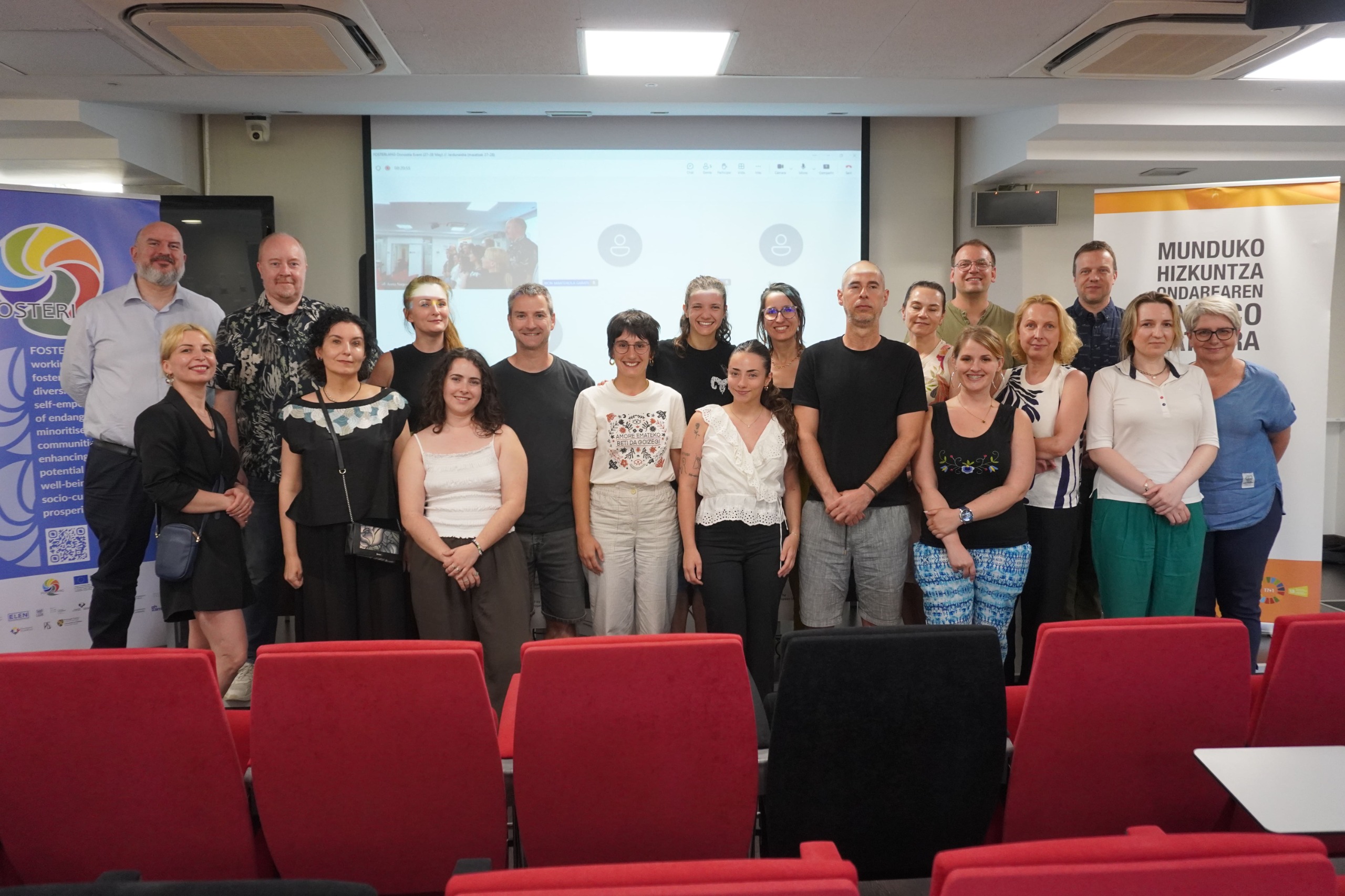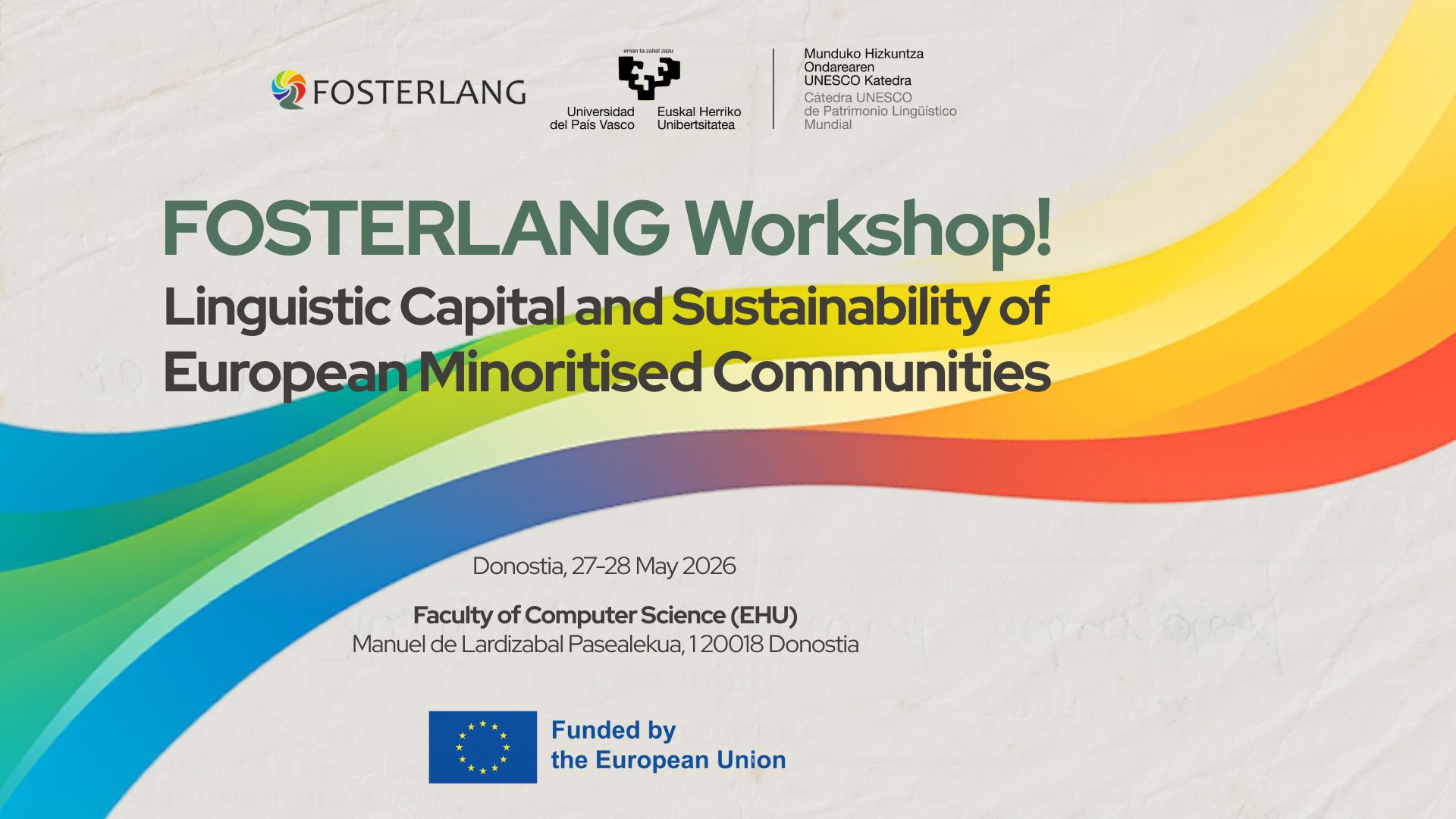
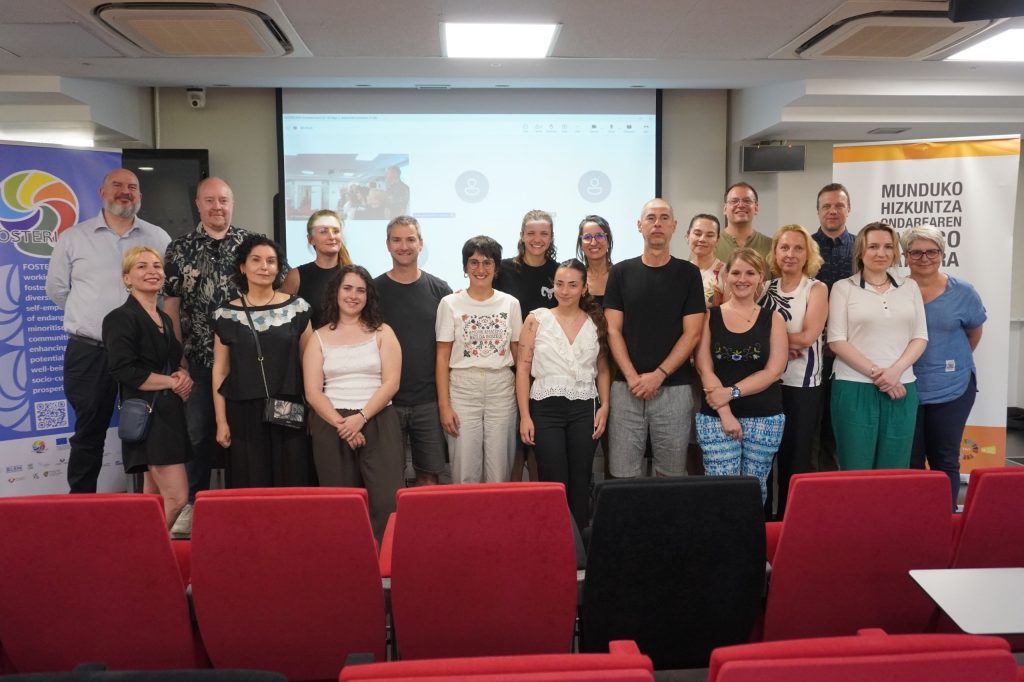
Researchers, language activists, policymakers, and community representatives gathered in Donostia for a special FOSTERLANG workshop focused on strengthening the linguistic capital and sustainability of Europe’s minoritised language communities. Hosted at the University of the Basque Country (UPV/EHU) and organised by the UNESCO Chair of World Language Heritage, the event formed part of the Horizon Europe-funded FOSTERLANG project.
Exploring Linguistic Capital
Opening the event Justyna Olko (Univ. Warsaw) and Ibon Manterola (EHU) discussed the concept of “linguistic capital” — the social, cultural, and economic value that languages bring to communities. This was followed by Iñaki Marko and Jone Goirigolzarri-Garaiza who focused on minoritised language revitalisation and the framework of community capitals, using the Basque E5 project as an example.
Elin Haf Gruffydd Jones (Univ. Wales) and Gòrdan Camshrom (UHI) led the panel on linguistic capital at work referring to the impact of industrialization on Welsh and the national Gaelic language plan in Scotland.
Three examples illustrated how linguistic capital is being developed and how community driven projects can support a language. Ceri Cunnington spoke about the Bro Ffestiniog initiative in north Wales, Gordon Camshrom focused on Taigh Ceilidh, a community hub, on the Isle of Lewis, and Anna Kościukiewicz-Jabłońska talked about her work for Kashubian language radio.
Kasia Wojtylak discussed how indigenous owned eco-tourism was helping the Kuku Yalanji language in Australia and Izar Mendiguren highlighted the Aiaraldea community project where the activist owners decided to make the project a Basque language “breathing space”.
Language Transmission and Community Sustainability
The afternoon session focused on language transmission and socialisation. Speakers highlighted the importance of intergenerational language transfer and the role of families, schools, and community organisations in maintaining linguistic vitality.
Justyna Olko spoke about the challenge of transmission referring to minoritised and migrant language communities in Europe. Emili Boix-Fuster looked at the relationship between inter-generational language transmission and language revitalisation. Daniel Wutti examined Slovenian in Carinthia. Artur Jablonskji discussed the transmission and use of minoritised languages in Poland, with a focus on Kashubian.
The afternoon continued with Elin Haf Gruffydd Jones discussing the the TRIAUD model (Transmission, Acquisition, Use and Development) of language development and the current context in Wales . Agnieszka Otwinowska, Emilia Wąsikiewicz-Firlej and Anna Szczepaniak Kozak spoke about the Role of Education in the Kashubian and Lemko communities. Lastly, Maite Garcia spoke about the transmission of Basque, socialization in Basque, and family language policy.
Digital Technologies for Minoritised Languages
The second day of the workshop showcased the growing importance of digital technologies in language preservation and demonstrated how technological innovation can help combat digital exclusion and strengthen linguistic resilience.
Federico Gaspari and Catalina Armengual Ripoll (DCU, Adapt Centre) gave a detailed presentation on machine translation quality evaluation and post-editing for minoritised languages.
Arvind Kumar spoke about Automatic Speech Recognition (ASR) for minoritised languages. He discussed the challenges in ASR modelling for low-resource languages and the current state-of-the-art technologies. In addition, he provided a basic hands-on experiment on Google Colab to fine-tune a model using an existing dataset.
Paul Trilsbeek (MPI) gave a presentation on the use of language archives with regard to minoritised languages. This session will focus on finding and getting access to digital materials in different language archives.
The session closed with a presentation by Joanna Dolinska (Univ. Warsaw) on creating linguistic corpora for languages with no unified written standard.
The presentations and videos of the workshop are available on the Fosterlang website. Pictures of the event are on the Fosterlang Facebook page.