
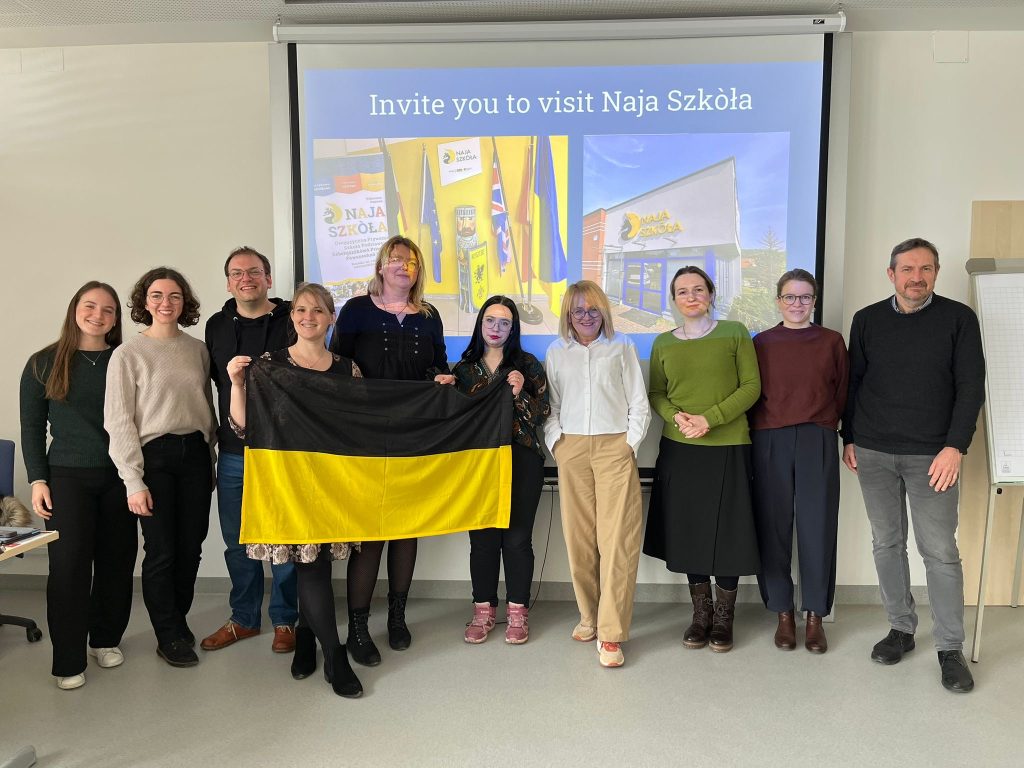
From 26th to 29th January 2026, director Hanna Ellwart and two teachers, Juliô Domarus and Magdalena Klimek, from the Kashubian minority school “Naja Szkòła”, located in Wejrowò/Wejherowo, visited Kärnten/Koroška/Carinthia in southern Austria to gain an insight into the bilingual education system of the Slovene-speaking minority in Carinthia. The guests themselves belong to a linguistic minority—the Kashubians in Poland. The aim of the visit was to become familiar with the diversity of Carinthia and to exchange practical experiences in and about minority education systems.
The project team at the University of Teacher Education Carinthia (PHK), under the leadership of Dr. Daniel Wutti, prepared a varied and highly informative programme offering school-based insights, cultural encounters, and numerous opportunities for exchange and in-depth discussion.
On Monday the group visited Ljudska šola 24/Primary School 24 in the region’s capital Klagenfurt/Celovec. Many impressions were gathered through lively exchanges between the visitors, teachers, the principal, and the children. Afterwards, the bilingual mountain villages of Sele/Zell and Slovenji Plajberk/Windisch Bleiburg were explored, followed by a lunch featuring typical Carinthian dishes. The final item of the day was a study visit to the bilingual Montessori early-childhood centre in Ferlach/Borovlje.
Tuesday began with another school visit, this time to VS/Lš primary school in Ledince/Ledenitzen, where the Kashubian partners familiarized themselves with modern methods of bilingual education in Carinthia. The guests then visited the Slovene Institute of Ethnology “Urban Jarnik” in Klagenfurt/Celovec and exchanged about research activities in the field of Carinthian Slovene anthropology as well as political and cultural activities.
On Wednesday the focus was on direct exchange and professional discussion with the Institute for Multilingualism, Minority Languages, and Transcultural Communication at the University of Teacher Education Carinthia (PHK), as well as a meeting with the PHK Fosterlang team. The exchange was considered very fruitful by both sides, and further exchanges, e.g. in northern Poland in the coming months, are to follow. Interviews on the educational situation will also be conducted with teachers from the Kashubian minority in the near future, and the results will be incorporated into Fosterlang Research (WP3). Another equally engaging item followed in the afternoon: during a guided city tour, participants explored traces of minority communities in Klagenfurt/Celovec.
Thursday was devoted to school visits and detailed discussions with those responsible for bilingual education in Carinthia, giving the director and teachers of Naja Szkòła the opportunity to become acquainted with VS/Lš Hermagoras/Mohorjeva and VS/Lš Šentlenart/Siebenbrünn, a minority school in an area where most pupils do not speak Slovene at home anymore.
The visit helped build bridges between the two language communities and provided inspiration for future educational work.