Deliverable 4.1 Basque
The Basque case: Aiaraldeko Ekintzen Faktoria
Euskara, the Basque language, is one of Europe’s minority languages and a cornerstone of identity in the Basque Country. Despite its official status alongside Spanish, its everyday use remains fragile in many areas. In Aiaraldea, a region of nine towns in the province of Araba with around 34,000 inhabitants, the project Aiaraldeko Ekintzen Faktoria (AEF) has emerged as a dynamic initiative that integrates language revitalization with community development.
The Linguistic Landscape of Aiaraldea
The Basque Country (Euskal Herria, in Basque) stretches across both sides of the western Pyrenees and is historically composed of seven provinces. Today, these are divided into three administrative entities: the Basque Autonomous Community (Araba, Bizkaia, and Gipuzkoa) and Navarre within Spain, and the Northern Basque Country (Lapurdi, Nafarroa Beherea and Zuberoa) in France. Despite these political boundaries, the region shares a deep cultural and linguistic heritage centered on Euskara—the Basque language—one of Europe’s oldest and the only non-Indo-European language in the area. With around 750,000 speakers, Euskara enjoys official status and active promotion in the Basque Autonomous Community and parts of Navarre, while revitalization efforts continue in the French Basque Country. Yet, despite significant progress—especially in the Basque Autonomous Community—it remains a vulnerable, minoritized language.
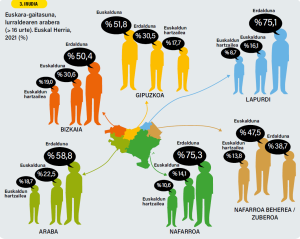
Recent data reveal stark territorial differences in Basque proficiency. As Figure 1 below shows, Gipuzkoa leads with 51.8% of its population able to speak Basque, followed by Bizkaia (30.6%) and Araba (22.5%). Across the border, the numbers drop sharply: only 14.1% in Navarre and 16.1% in Lapurdi speak Basque, with both regions dominated by non-speakers (over 75%). Nafarroa Beherea and Zuberoa stand out among the northern territories, where nearly half the population (47.5%) speaks Basque. These figures underscore a clear divide between areas where Basque thrives and those where it struggles, highlighting the need for strong regional policies and cultural initiatives to sustain the language.
In Aiaraldea, progress has been remarkable: 35% of residents over five reported Basque knowledge in 2021, up from just 4.4% in 1981. However, Spanish remains the dominant home language (85.2%), with Basque at 4.7%, bilingual households at 6.1%, and other languages at 4.1%. Only 9.7% of Basque speakers are native, while 14.1% grew up bilingual; the majority (76.2%) learned Basque through school or adult education. Despite this, everyday use is limited—just 2.8% of households use Basque exclusively, and 9.1% mix Basque and Spanish. Street use has also declined, from 9% in 2011 to 4.6% in 2021.
Spanish dominates most social spheres, though education offers hope: infant, primary, and secondary schooling is largely delivered in Basque, with Spanish taught as a subject. This reflects both the progress in language acquisition and the ongoing challenge of ensuring intergenerational transmission and daily use.
Aiaraldeko Ekintzen Faktoria Project
AEF began as a local Basque-medium broadcasting initiative, similar to other media projects across the Basque Country. Over time, it has evolved into a “holistic” or “cross-sectional” community development project that integrates diverse activities under one roof. These include a shop for local agricultural and ecological products, a cultural venue for concerts and artistic residencies, leisure programmes for children, and hosting activities for families of migrant backgrounds, including the creation of multilingual resources.
AEF also runs a transmedia project encompassing web, radio, blogs, and print, all conducted through the medium of Basque. While language revitalization is central, the project’s broader mission is community transformation, embedding Basque into socio-economic and cultural life, to strengthen the use of Basque. Practitioners describe AEF as a form of place-branding, with its new pavilion serving as a unique site where activities are dominantly carried out in Basque.
Positive Impact on the Linguistic Community
AEF is a cooperative-based organization with 23 employees, 500 partners, and an annual budget of around €1 million. In 2021, it opened a 750 m² pavilion that has become a vibrant hub for cultural and social activities, strengthening the presence and legitimacy of Basque in everyday life. Two years later, AEF conducted a social balance study to quantify its impact, revealing an impressive result: for every euro Faktoria receives, it generates €11 in social value.
This pioneering work also led to the creation of the Aiaraldeko Euskalgintzaren Kontseilua (Council for Basque Language Advocacy of Aiaraldea), a collaborative platform that brought together previously fragmented local language activists and organizations to share insights and coordinate strategies.
By embedding Basque into commerce, culture, leisure, and media, AEF demonstrates that language revitalization thrives when linked to broader community development. Its initiatives have created jobs, strengthened local identity, and offered a powerful model for integrating minority languages into modern socio-economic frameworks.
Looking Ahead
The Basque case in Aiaraldea illustrates how language revitalization must go hand in hand with community development. While Spanish remains dominant, initiatives like AEF show that Euskara can thrive when embedded in cultural, social, and economic life. By creating spaces where Basque is the natural medium of interaction, AEF not only strengthens linguistic vitality but also fosters resilience, identity, and pride in the community.
Figure 1. Linguistic competence in the seven provinces of the Basque Country.